Like

Showing posts with label Cooking. Show all posts

Monday, May 30, 2011

"I don't LIKE food. I LOVE food. If I don't love it, I don't swallow."


The problem with cooking is that it is highly subjective. No doubt Ego loves food that I don't and vice versa. Even Skinner, who more resembles Ego than I (if only in animation) does not get transported by his Ratatouille in quite the same way. Personally, I’ve had differences in opinion from all the food critics I’ve followed. What then, will enable our restaurant to be successful if 1) diners follow critics whose advice I don’t follow myself, 2) sometimes trend, not the food itself, dictates success and most importantly 3) cooking is so subjective?

A lot of consumer restaurant reviews criticize, "the food was good, but nothing mind-blowing." What really strikes me is that restaurant patrons (and critics alike) want to see something new on their plates in order to grant the highest points to a particular restaurant. Put something completely new on their plates, and they insist that the “flavors don’t work.” Even molecular gastronomy, arguably one of the newest culinary traditions, reproduces classic flavors albeit in new shapes or forms.

I once had a woman criticize my cooking, saying that the particular dish was something she could have made herself. Though I didn't take her criticism well at the moment, I think it provides some insight into this current quandary of mine. That is to say, isn't the food that tastes like something you could have made yourself something that resonates most with your palate? Aren't the most popular restaurants often the ones that are most predictable, because they produce Mac and Cheese just how the generalized you remember it? Why do people profess to want something new when they fall back on what is known and familiar?

I guess I’m just trying to figure out what people look for when they go to a restaurant. And, given that tastes can be vastly different from person to person, how do you decide which subgroup to appeal to when putting together the character of your menu? How much of your own agenda (in our case, sustainability) do you put aside to appeal to customers’ taste buds, which for better or worse have been conditioned by excess sugars, fats, and salt?

Ultimately, there is no clear science to putting together a restaurant, or a concept, or a menu for that matter. Being Type A, an overachieving Asian, and Virgo all in one, I’ve pushed and pulled on TM to apply structure and frameworks to her menu planning. We’ve brainstormed, we’ve strategized, we’ve simplified, and then we’ve elevated, all in the hopes of appealing to this unknown person, a critic, a food blogger, a fat wallet patron, a regular old chum. All this when at the end of the day, what we should have been doing all along is designing a menu that we’d want to eat from day in and day out because we will be, after all. Isn’t that what upsets us about the current state of restaurants in LA? That is, there are too few restaurants with the kind of menu that we would eat from everyday, luxurious and healthy at the same time, sophisticated and sourced sustainably, and all with a conservative price point.

The realization that we should serve what we want to eat ourselves incidentally is the reason we started on this restaurant journey in the first place and came full circle while I was watching Jamie Oliver’s Food Revolution. (It is no coincidence that I begin and end this blog with a TV/film reference). He was astounded when a fast food operator told him that he wouldn’t change his restaurant’s menu because he served what his customers demanded. The implication is that food revolutions begin at the forefront of the industry, i.e. at restaurants, grocery stores, butcher shops, etc. Whether people will buy the food to begin with is somewhat irrelevant; most people will change their buying behavior when presented with better alternatives. I have no doubt that what we produce at home are better alternatives. So...who cares if you can make my food yourself? Please do, it's good for you and the earth.

Sunday, April 3, 2011

So long, deep fryer.

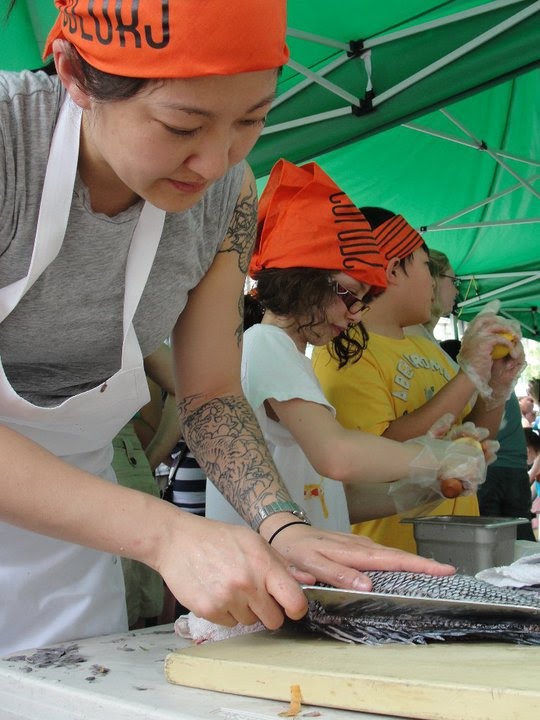
I have decided that I will work the fish station when our restaurant opens. After spending a year cooking fish in the kitchens of Bouley, Picholine, and Tabla in NYC, I moved into management because I wanted to learn more about the business. For the past 4 or 5 years, I focused on the front-of-house and managed the top and bottom lines, beverage programs, and the customer experience. Though service and ambiance are important, I've always believed that food is paramount in any restaurant. And, with some basics of restaurant management under my belt (including 6 successful restaurant openings and an MBA), I feel I can successfully train others to run restaurants without micromanagement. Therefore, without deliberately charting my path years ago, I have allowed myself the professional growth to return to where I will make the biggest contribution in my own restaurant, working directly with the food and alongside TM.

In light of this change of plans (initially TM would work in the kitchen and I would run service), we have been relentlessly re-imagining our menu. Because of her faith in my fish cookery - and my faith in her meat cookery - we are upping the ante, and taking bigger risks with more refined dishes. We will combine elements of food that speaks to one's soul, the fundamental key to TM's style so absent amongst even celebrated chefs, and layers of flavors captured though sophisticated textures, sauces, and cooking techniques. Watch our dishes develop in the coming months, they will be picture worthy.

Saturday, January 29, 2011

Anyone can cook!

Or bake! I starting a baking project because we plan to make our own breads once our restaurant opens. We are considering a baker/pastry chef, but how awesome would it be to do it ourselves?? It's actually a lot easier than I thought it would be especially since I have a great book, Tartine Bread, which gives step-by-step instructions. I decided to start w/ the basic country loaf, and bought 25 lbs of AP flour from Costco so I can experiment cheaply. Making a starter is the first step. By allowing water and flour to sit around and make bubbles for a week with a little attention each day, you no longer need commercial yeast. Suits me, and our artisanal concept.
After you starter becomes "predictable," you can work on a leaven, which as I understand it, is simply a starter that is more calculated. You measure out proportionate weights of water and flour, and leave it to ferment with just a smidge of your original starter for about 12 hours, or overnight. So far I've made 2 batches. The first batch had a leaven that was left out for 16 hours, the second had a leaven of 6. You know it's ready to go when it floats in water. The flavor was slightly more pronounced with the first batch, but the final products were more or less equally aerated. This leaven is key to the bulk fermentation, or the paper mache stage, as I see it. You mix lots of flour with warm water, salt and the leaven and you get a sticky wet mess that you flip around every half hour or so for 4 hours. A proper leaven, and proper flipping for that matter, initiates the accumulation of air in your dough. Chad recommends to wet your hands before flipping, but I found that that adds extra water and makes the mache more messy.
The next stage is more lovely than the paper mache stage. Basically, you allow your dough to stretch out and rest on a bench...or cutting board if you aren't fancy enough to own a baker's bench. This stage seems the most bread-like, because you're actually pulling and stretching on the dough. With Chad's method, you never actually knead the dough, which is a little disappointing because I've always imagined bread-making to require some kind of obscure baker's "touch," but at the end of the day if you can get the same results without actually working, I'm down. After a very calculated 4 hour final rise, I noticed my dough gained about 25 percent in volume and was light and fluffy to the touch. At that point, I knew it was time to throw my cast iron combo cooker into the oven to heat. My first batch had to go without rice flour because I didn't have any so the bottom crust got thick and dark. I also scored the loaf with a dull knife so the surface looks almost silly. The second time, I used rice flour exclusively and the bottom crust was much more palatable. I also sharpened my knives (I'm not quite sure why he recommends a razor instead of a sharp knife, but I suppose I will learn once I get a razor). These are my first and second attempts, side by side.

Anyway, I think I did a pretty good job. The crust was light and crackled, the tunneling was very pronounced, and the bread had good flavor. A few deviations from Chad's method - I don't have a bench knife, a razor, a thermometer (TM told me on my first batch that the temperature of my water was somewhere between 65-70 degrees, so I guess I don't really need one), or a small scoop. The only tools I would say are absolutely key (for Chad's method, at least) are a digital scale and a cast iron oven. Also, I did both rises (bulk and final) during the day, which for the last few days meant in 75 degree weather. We didn't get to eat the bread until 11pm at night. Since we'll be baking for lunch and dinner service, I'm trying my third batch with a final rise in the fridge so that I can bake first thing in the am. Also, my former boss at Le Pain Quotidien just shipped some very fancy organic wheat flour to me. I'm super excited to see how the results improve with a better product.

Thursday, December 16, 2010

About LP

I am a 31-year-old Chinese-American woman who caught the restaurant bug (for better or worse) seven years ago and decided to act on it. In 2004, I dropped out of an English PhD program at NYU to become a line cook at Bouley, the #2 NYC Zagat rated restaurant for food in 2004. I walked in with no professional kitchen experience, and I walked out six months later having obtained the Chef de Partie position on the fish line. It was luck that got me that position (the Chef liked my tattoos) and it was pluck that kept me there (believe me, I had to come up with some creative solutions to the problem of not knowing how to cook professionally). Despite my simplistic description, this was the hardest experience of my life - the physical demands of rushing and hustling the entirety of 72 hours a week plus the emotional stress of a precise, high-volume, and all-male professional kitchen in the culinary capital of the world would have broken any other sane female and forced her to go back to her office job. Instead, I experimented with a dozen other high-profile restaurants, looking for a food experience that would top my first AND a work environment that would not keep me on the verge of tears (get to know me, I'm not a crybaby). I settled for short periods of time in a couple of other kitchens, Picholine and Tabla, but ultimately decided that my two requirements might not exist in combination.

With a little luck in 2005, (the GM at the time was a foodie who admired my kitchen experience), I moved into the FOH with a serving and bartending gig at SushiSamba, a very popular Japanese fusion restaurant that had just been featured on Sex and the City. I made between $250 and $500 a night in tips, and in four months erased the $7k in debt I had accumulated by working for $400 a week in the kitchen. My luck ran out quickly because the GM left, only to be replaced by an arrogant hack who decided to weed me out. I walked out after being denied a break in an exceptionally busy 16-hour day.

Tired of the NYC restaurant scene, I returned home to LA to look for a job in management, where I might have a hand in making management more equitable. I applied for an entry-level position with Le Pain Quotidien in mid 2005 and again, found some luck when the hiring manager knew the SushiSamba GM who had hired me there (she left SushiSamba for Le Pain Quotidien). Though my experience at Le Pain Quotidien was not without frustration (I was forced to open a new location against my will, upper management was somewhat of a "boys' club"), I made the most out of my experience to become one of the strongest managers in the LA region. More important than launching my management career, Le Pain Quotidien provided the opportunity to put together my own teams; I learned to match diverse personalities that summed to teams that hum. It’s hard to describe, but good team dynamics are some of the sexiest elements of the restaurant industry to me.

In all of my restaurant experiences, I had never been enabled to make truly positive working environments for myself or my co-workers. I have heard the most derogatory language used towards restaurant workers, and I disagree that the industry is without intellectuals or talented workers. In an idealistic move intended to enable me to change circumstances in the industry (both for myself and others), I applied to, and eventually was accepted into, the 2008-2009 accelerated MBA program at Columbia Business School. The program was a lot easier than I would have expected given that it was filled with fancy finance guys from Wall St. In my opinion, it is harder to manage people successfully than to put together financial projections for multi-million dollar mergers. Though I never learned anything useful about people management, I did gain a lot of confidence around numbers, specifically Accounting and Finance. Because I graduated in a recession, I couldn’t realize either of the goals I had in going to business school: to gain the investor interest to launch a restaurant, or obtain a high-paying consultancy position so that I could accumulate the cash or fund-raising experience necessary to eventually launch a restaurant.

In mid 2009, I returned to Border Grill, my employer prior to business school. In starting up their mobile catering operation, I experienced the same mismanagement I struggled against in my entire career in the industry (i.e. poor wages, long working hours, micromanagement). But I also met Teresa, a talented and stubborn young sous chef with so much potential and passion for the industry. Her enthusiasm and positivity was infectious, and I wanted to be near her all the time. Though she had a lot to learn herself, she was the first person in a long line of managers I felt had something to teach me. She was bold enough to tell me what she thought of my management style, and what she told me resonated with how I wanted to grow professionally but never allowed myself to do. I fell in love with her tenacity, her fierce loyalty, her generosity, her understanding of how food speaks to the soul, and the energy we created when we worked together. I trusted her work completely and loved that she brought something unique and fresh to the management of our teams. When I received an exit opportunity, we seized the chance to move and experience NYC together.


The opportunity was to work for a non-profit organization dedicated to improving conditions for restaurant workers. My job was to turn around a struggling worker-owned cooperative restaurant. If successful, I would receive 10% of profits, and the knowledge that I was finally running a restaurant that valued hard-working employees. I shouldn’t have been so naïve to think that things are as they seem. The restaurant was over $1mm in bank debt (which I knew about going in) AND $70k in vendor debt (which I didn’t know about going in). When 3 years of $50k/month grant funding dropped by half only 2 months after we launched dinner service, I needed the entirety of the $60k in start up capital I was granted to keep us afloat through the summer season, which is notoriously deathly for the NYC restaurant industry. What was worse was that I never had complete control over my team composition. When I realized that my hard work went to employ – and would, if the restaurant became profitable, make rich – a manager I completely opposed, I knew that the only situation in which I could compel my employees to grow, work hard, and experience a healthy and supportive working environment would be one that I would create with Teresa.