More annoying than bad food is bad service. I can leave a restaurant that serves bad food feeling sorry for it, but I seethe when I leave a restaurant with bad service. I think this is all common sense, but apparently it isn't and I have to list out what not to do if not to better the service in this town than just to vent a little.
Don't:
1. pretend to do me a favor by seating my incomplete party even when the restaurant is half empty. Either seat me or don't.
2. drop a menu that has clearly been printed on a home printer without checking first whether the dumb nut that trimmed it down passed kindergarten and can cut in a straight line.
3. ask two people with three place settings (that the host set) whether there are two or three people in the party.
4. interrupt a lively conversation at a table so that you can take a drink order.
5. ask to take a drink order even before a customer is able to get his coat off after he first sits down.
6. tell me what your favorite dish is, why do I care what your favorite dish is? Is your palate identical to mine? Do you even have a palate?
7. notice that a customer is trying to fix a wobbly table and walk away.
8. deliver food and leave empty beer glasses on the table.
9. allow your busser to provide the best service in the house.
10. touch a check presenter that obviously has not been moved from where you set it and ask if "it's all set."
Just for posting this, I will probably be punished with an unjust review of my own restaurant's service when we finally open. Go ahead and judge me, but I will only stab myself in the eye if we get called out on any of the above 10 infractions.
Thursday, March 31, 2011

Friday, March 11, 2011
Food Photos
Loretta and I have decided to dedicate an entire blog to images of our food. We've included holiday meals, dinners with friends, dinners at home, our food at Colors restaurant and Sunday suppers. Enjoy!

This is a beef tartar that we served as an appetizer for Thanksgiving in 2009. It's fresh beef tenderloin, brandy, shallots and mustard seed caviar served with parmesan crisps.
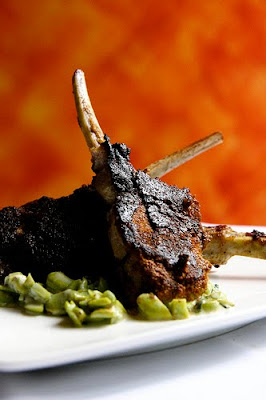
The photo above and the photos below is from our menu at Colors restaurant in NYC. Above is Yogurt marinated lamb chop with tandoori spices and fava bean salad. Photos by Nadine Friedman.


From left to right:
Bagna Cauda Salad: prosciutto, cherry tomato, arugula, fennel and an anchovy vinaigrette
Local Cheese plate: raw orange blossom honey
Brazilian Mussel Moqueca: ginger coconut broth and lime
Three Grain Salad: farro wheat salad with dried cherries, quinoa with pistachio pesto, and cous cous with madras curry and coconut

Clam and Chorizo: Little Neck clams, chorizo, fennel, and a smokey white wine sauce. We sopped it up with some of Loretta's delicious bread.
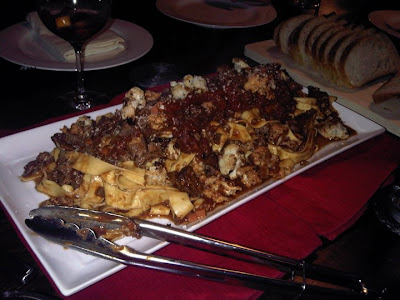
This isn't the most flattering picture but this is one of my favorite dishes to make. It's a lamb ragu with pappardelle. This is a version of a dish we did at Colors, only that version used local beef short ribs that were to die for and house made pasta!
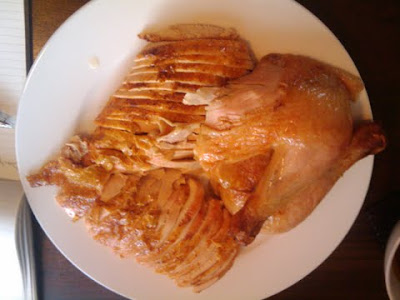
One of our favorite things to make at home is roasted chicken. At least once a week we roast a whole organic bird, it's so satisfying and we tend to get about three hearty meals out of one five pound chicken. It's definitely one of my favorite things and if you ask Loretta what her favorite dish of mine is...she will say "the chicken".
 Home Cured Maple Bacon. Since I've cured my own it's very unlikely that I will ever buy bacon again.
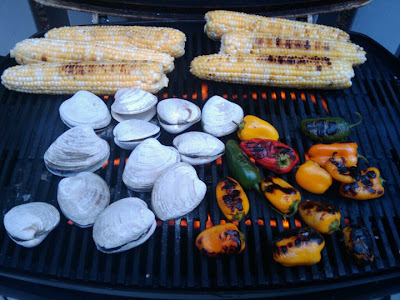
I guess we have a thing for clams. We picked these up at a little fish market in South Hampton.

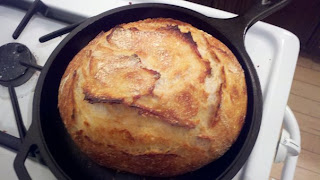
Loretta's gorgeous bread! She's so talented.
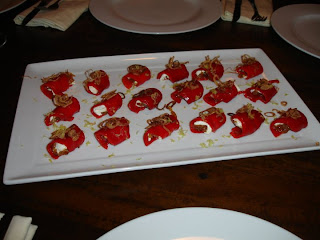
These little guys are cheese stuffed piquillo peppers with fried shallot and lemon zest.
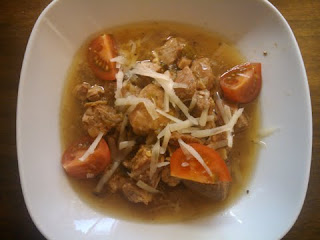
Green Chile Stew: pork shoulder, green chiles, tomato, cheese...yum!
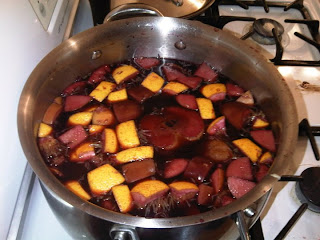 I'll end with a shot of Loretta's Mulled Wine Sangria. It's red wine, fruit, cinnamon, and brandy...it's amazing served warm or chilled. Cheers!

This is a beef tartar that we served as an appetizer for Thanksgiving in 2009. It's fresh beef tenderloin, brandy, shallots and mustard seed caviar served with parmesan crisps.

The photo above and the photos below is from our menu at Colors restaurant in NYC. Above is Yogurt marinated lamb chop with tandoori spices and fava bean salad. Photos by Nadine Friedman.


From left to right:
Bagna Cauda Salad: prosciutto, cherry tomato, arugula, fennel and an anchovy vinaigrette
Local Cheese plate: raw orange blossom honey
Brazilian Mussel Moqueca: ginger coconut broth and lime
Three Grain Salad: farro wheat salad with dried cherries, quinoa with pistachio pesto, and cous cous with madras curry and coconut

Clam and Chorizo: Little Neck clams, chorizo, fennel, and a smokey white wine sauce. We sopped it up with some of Loretta's delicious bread.

This isn't the most flattering picture but this is one of my favorite dishes to make. It's a lamb ragu with pappardelle. This is a version of a dish we did at Colors, only that version used local beef short ribs that were to die for and house made pasta!

One of our favorite things to make at home is roasted chicken. At least once a week we roast a whole organic bird, it's so satisfying and we tend to get about three hearty meals out of one five pound chicken. It's definitely one of my favorite things and if you ask Loretta what her favorite dish of mine is...she will say "the chicken".
 Home Cured Maple Bacon. Since I've cured my own it's very unlikely that I will ever buy bacon again.
I guess we have a thing for clams. We picked these up at a little fish market in South Hampton.


Loretta's gorgeous bread! She's so talented.

These little guys are cheese stuffed piquillo peppers with fried shallot and lemon zest.

Green Chile Stew: pork shoulder, green chiles, tomato, cheese...yum!
 I'll end with a shot of Loretta's Mulled Wine Sangria. It's red wine, fruit, cinnamon, and brandy...it's amazing served warm or chilled. Cheers!
Tuesday, March 8, 2011
Sunday Supper #2 Quack, Quack!
For Sunday Supper #2 we focused on Duck. After the first Sunday Supper we thought we should focus in one animal and make a three to four course meal out of that animal. The duck was especially fun for me because they are so fat! Loretta had been practicing her flatbread and I had a pork belly curing so we really wanted to incorporate those elements to show our craftsmanship.
Our general feedback was incredibly positive. The challenges we faced with this supper was the large crowd. We found ourselves with fifteen hungry guests in our home, most of which work in the food industry and are self professed foodies. To be honest we didn't think everyone we invited were gonna show so we kept inviting and inviting. Loretta decided that I should be the front of house for this supper which was probably not the best thing for us but I muscled through it...clearing plates, trying not to spill on people and making sure we were on track in the kitchen. The conversation was stimulating. A bit off topic at some points but I think we fed everyone too much wine. Upon talking over our concept with everyone, a couple of our guests said that we "don't have to worry about the food" and that we should focus on our story. "What story? We're opening a restaurant", I thought. It has to be about the food! We have to keep pushing the envelope and keep trying to invent and create and learn. That's what this is all about! No?
Photos by Christina Yamasaki (thanks X)
The Menu:
My thoughts are in red
We started with two pintxos (sorry no pictures on these ones):
Duck liver pate with fresh orange and chives
This dish was nice, I balanced the liver with some sherry vinegar to tone it down a bit as well as some fresh herbs. I was hoping that it was not just a dish only a liver lover can appreciate.
White bean puree, duck confit, and confit mushrooms
We had a couple legs and thighs left after we decided the menu on paper so I put them on to confit over night with some pretty miatake mushrooms. I was happy with this pintxo.
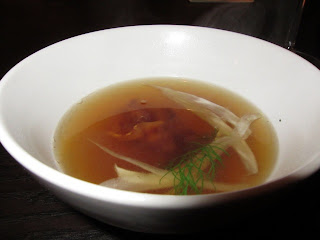
First Course: Duck Consomme with preserved lemon, fennel and crispy juniper bacon
I made a rich, sexy duck stock and seasoned it with star anise, juniper berries and some smoked paprika. The little hints of flavor can be perfected but the addition of a crispy piece of bacon at the end was my favorite element.
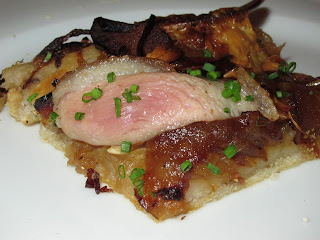
Second Course: Olive Flatbread with pan seared duck breast, caramelized onion, apple and manchego cheese
Loretta's flatbread was spot on. We have some tweaking to do to the cook time but the flavor profile of this dish was pretty solid. We tested this dish twice before serving it, we kinda like it.
Loretta's flatbread was spot on. We have some tweaking to do to the cook time but the flavor profile of this dish was pretty solid. We tested this dish twice before serving it, we kinda like it.
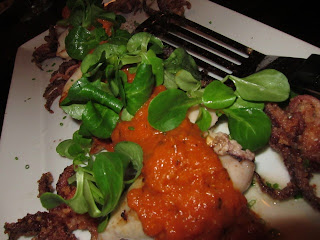
Third Course: Relleno de Calamari, squid stuffed with homemade duck sausage and potatoes with salsa brava and mache salad
This dish came from an experiment at Colors in NYC. I had a menu item called Daily Seafood Preparation or something which basically meant I could do whatever i wanted under the broad umbrella of seafood. I had a sample of hot Italian style sausage from my meat guy so I thought I'd cook it up with some potatoes and stuff the mixture into calamari and grill it...so I did...and it was good. I applied the same idea but used duck sausage that I made at home which I tested at Thanksgiving. The salsa brava adds a nice bite of acid and heat while the fatty sausage complements the lean meat of the calamari. We also gently deep fried the tentacles for a little textural contrast. This dish was well received by my guest. I think it's a keeper.
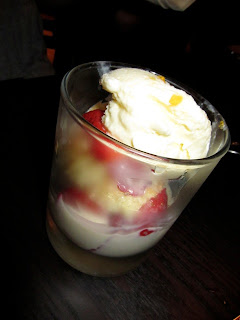
Final Course: Crema catalana ice cream with olive oil cake
We tried...we're not pastry people but we put this out there anyway. The flavor was right but the cake was just not quite there. We have more success in this department when we keep it simple...and I mean really simple. We'll work it out!
Our general feedback was incredibly positive. The challenges we faced with this supper was the large crowd. We found ourselves with fifteen hungry guests in our home, most of which work in the food industry and are self professed foodies. To be honest we didn't think everyone we invited were gonna show so we kept inviting and inviting. Loretta decided that I should be the front of house for this supper which was probably not the best thing for us but I muscled through it...clearing plates, trying not to spill on people and making sure we were on track in the kitchen. The conversation was stimulating. A bit off topic at some points but I think we fed everyone too much wine. Upon talking over our concept with everyone, a couple of our guests said that we "don't have to worry about the food" and that we should focus on our story. "What story? We're opening a restaurant", I thought. It has to be about the food! We have to keep pushing the envelope and keep trying to invent and create and learn. That's what this is all about! No?
Photos by Christina Yamasaki (thanks X)
Thursday, February 17, 2011
The home of Ración
A few weeks after fruitlessly seeking retail spaces on foot and on loopnet, some of our downtown dwelling friends told us to check out the up-and-coming area along the Broadway Corridor. Driving around, I found a promising retail space at the Blackstone Lofts and decided to take Teresa to scope it out that same night. As we were poking around, she noticed For Lease signs going up in the windows across the street. The spaces were part of the historic Eastern Columbia Building, gorgeous at 11 o'clock at night.

For some very lucky reason, the current tenants Mark and Lisa were just settling into the space with their gallery and had the doors open as they worked. We wandered in, and immediately found common ground on the beauty of the space and the emotionality of the artwork. Something in the explanation of our restaurant concept must have resonated with them because not only did they show us the adjacent retail space (which was smaller, and ultimately what we set our sights on), but they showed us the loft that they owned, and called the owner of the retail space the next morning on our behalf. Within a few days, we had met with the owner and brokers and had an LOI in the works!
When we embarked on our effort to find a space for our restaurant, I had no idea what to look for, what to negotiate, how to phrase my negotiations. With the help of MANY friends (lawyers, architects, designers, business owners and operators, local residents) we pieced together a few documents that made sense to us and the nature of our business. Though not without a few painful moments, the process of finding our restaurant spot is exactly what I envision for Ración: a combination of a little luck, a gut reaction that this just feels right, and the combined interest of a whole group of very cool people.

For some very lucky reason, the current tenants Mark and Lisa were just settling into the space with their gallery and had the doors open as they worked. We wandered in, and immediately found common ground on the beauty of the space and the emotionality of the artwork. Something in the explanation of our restaurant concept must have resonated with them because not only did they show us the adjacent retail space (which was smaller, and ultimately what we set our sights on), but they showed us the loft that they owned, and called the owner of the retail space the next morning on our behalf. Within a few days, we had met with the owner and brokers and had an LOI in the works!
When we embarked on our effort to find a space for our restaurant, I had no idea what to look for, what to negotiate, how to phrase my negotiations. With the help of MANY friends (lawyers, architects, designers, business owners and operators, local residents) we pieced together a few documents that made sense to us and the nature of our business. Though not without a few painful moments, the process of finding our restaurant spot is exactly what I envision for Ración: a combination of a little luck, a gut reaction that this just feels right, and the combined interest of a whole group of very cool people.
You should know our concept: The Executive Summary
The Opportunity
If you ask Angelenos where to get good Spanish food in the city, they will send you to the temple of molecular gastronomy in LA, The Bazaar, or trendy wine bars that include so-called “tapas” as an afterthought, or worse yet, shoddily-run smaller businesses with little ambiance and low-quality food. Ración will address the gap of high-quality, affordable, and casual Spanish-cuisine dining in Los Angeles. Specifically, it will provide sustainably-sourced, unique preparations of traditional Spanish cuisine in a design-forward, modern setting with a European feel and casual, hospitable, and knowledgeable service.
The Concept
Ración seeks to combine the dining traditions and flavors of Spain with the consciousness of a modern Californian dining experience. Ración will introduce a new level of sustainability to the food services industry, one that extends beyond food sourcing and energy efficiency to include sustainability in preparing and serving food. Ración will be an inventory-driven restaurant that creates from what is available rather than allowing a pre-set menu to dictate what it orders, prepares, and inevitably wastes. In addition, Ración will creatively use every part of whole animals to avoid the wastefulness of cooking with “prime” cuts, and reduce hierarchy in its service structure so that employees are empowered to be more productive. Ultimately, Ración hopes to introduce an ever-evolving concept of sustainability to restaurant operations, one that ultimately brings financial benefits to staff and customers.
The Market
Ración’s target market will be customers in Los Angeles who consider themselves “foodies” on two levels: 1) culinarily adventurous and 2) those who are interested in Ración’s sustainability element. Additionally, because Ración aims to realize financial savings through reduction of wastefulness, Ración’s target market includes individuals who are working and value-driven.
The selected location for Ración is in the Eastern Columbia retail space in the Broadway Theater District downtown, at 847 S. Broadway, Los Angeles 90014. The area is in walking distance to dense populations of local loft dwellers, commuting office workers, and the entertainment centers of LA Live and the Staples Center. The area has also received significant media attention as the focus of Councilman Jose Huizar’s economic development effort “Bringing Back Broadway.” As part of the revitalization effort, plans are in place to bring a streetcar connecting the Broadway corridor, the Financial District, and the Historic Core by 2014. RCH Studios, whose client list includes Shutters on the Beach and the W Hotels, has been selected as the architect for the project.
The Competition
Ración’s competition will exist in Downtown LA food-forward restaurants and Spanish-inspired restaurants throughout Los Angeles. There are currently no restaurants in LA that combine moderate prices, sustainable sourcing, and food-forward Spanish cuisine.
The Management
Teresa and Loretta have launched several projects jointly: the Border Grill Truck in LA, COLORS Restaurant in NYC, and COLORS Café, also in NYC. Together, they have determined the strategic directions of multiple concepts, created dynamic and successful teams, and received unprecedented, positive reviews for both food and service. Teresa and Loretta will act as chef and general manager, respectively, through Ración’s first phase of growth.
Loretta Peng: Loretta is an experienced restaurant operator who has launched three restaurants for Le Pain Quotidien in Los Angeles and a mobile catering operation for Border Grill, also in Los Angeles. Most recently, she rebranded COLORS, a struggling fine dining restaurant in New York City around themes of sustainability and launched a more casual outpost, COLORS Café at the NYU Wagner School of Public Service. Prior to her foray into management, Loretta held a Chef de Partie position at the two-Michelin starred Bouley in NYC. She graduated in May 2009 with an MBA from Columbia Business School and holds undergraduate degrees in Economics and American Literature from UCLA.
Teresa Montaño: Teresa is an experienced chef who has led several high-performing culinary teams to rave food reviews both in LA and NYC. She is driven by sustainability in farming and cooking, and has held positions at the Vital Zuman Organic Farm in Malibu and at Tender Greens, the casual organic restaurant. As Sous Chef for Food Network stars Susan Feniger and Mary Sue Milliken, Teresa led the start-up of the Border Grill Truck and earned an internship at the pioneering organic restaurant Nora in Washington DC. She then went on to serve as Executive Chef for COLORS in NYC and conceptualized a locally-sourced menu of global small plates, leading the kitchen to its best reviews since the restaurant launched. She attended the Art Institute of California, Los Angeles for Culinary Management.
The Financials
The amount of equity and debt capital required to launch Ración and cover operating expenses until the restaurant is profitable is $485,282 ($282,700 in start-up expenses, and $202,582 in operating expenses). Financial projections expect revenues to be $1,500,300 at the end of Year 2, with EBIT of $150,400.
Want More?
Check out our history, track record, philosophical musings, and launch process on our blog at www.loloandtere.blogspot.com.
Contact Information
Loretta Peng
310.429.8742
loretta@racionrestaurant.com
Teresa Montaño
323.877.4901
teresa@racionrestaurant.com
If you ask Angelenos where to get good Spanish food in the city, they will send you to the temple of molecular gastronomy in LA, The Bazaar, or trendy wine bars that include so-called “tapas” as an afterthought, or worse yet, shoddily-run smaller businesses with little ambiance and low-quality food. Ración will address the gap of high-quality, affordable, and casual Spanish-cuisine dining in Los Angeles. Specifically, it will provide sustainably-sourced, unique preparations of traditional Spanish cuisine in a design-forward, modern setting with a European feel and casual, hospitable, and knowledgeable service.
The Concept
Ración seeks to combine the dining traditions and flavors of Spain with the consciousness of a modern Californian dining experience. Ración will introduce a new level of sustainability to the food services industry, one that extends beyond food sourcing and energy efficiency to include sustainability in preparing and serving food. Ración will be an inventory-driven restaurant that creates from what is available rather than allowing a pre-set menu to dictate what it orders, prepares, and inevitably wastes. In addition, Ración will creatively use every part of whole animals to avoid the wastefulness of cooking with “prime” cuts, and reduce hierarchy in its service structure so that employees are empowered to be more productive. Ultimately, Ración hopes to introduce an ever-evolving concept of sustainability to restaurant operations, one that ultimately brings financial benefits to staff and customers.
The Market
Ración’s target market will be customers in Los Angeles who consider themselves “foodies” on two levels: 1) culinarily adventurous and 2) those who are interested in Ración’s sustainability element. Additionally, because Ración aims to realize financial savings through reduction of wastefulness, Ración’s target market includes individuals who are working and value-driven.
The selected location for Ración is in the Eastern Columbia retail space in the Broadway Theater District downtown, at 847 S. Broadway, Los Angeles 90014. The area is in walking distance to dense populations of local loft dwellers, commuting office workers, and the entertainment centers of LA Live and the Staples Center. The area has also received significant media attention as the focus of Councilman Jose Huizar’s economic development effort “Bringing Back Broadway.” As part of the revitalization effort, plans are in place to bring a streetcar connecting the Broadway corridor, the Financial District, and the Historic Core by 2014. RCH Studios, whose client list includes Shutters on the Beach and the W Hotels, has been selected as the architect for the project.
The Competition
Ración’s competition will exist in Downtown LA food-forward restaurants and Spanish-inspired restaurants throughout Los Angeles. There are currently no restaurants in LA that combine moderate prices, sustainable sourcing, and food-forward Spanish cuisine.
The Management
Teresa and Loretta have launched several projects jointly: the Border Grill Truck in LA, COLORS Restaurant in NYC, and COLORS Café, also in NYC. Together, they have determined the strategic directions of multiple concepts, created dynamic and successful teams, and received unprecedented, positive reviews for both food and service. Teresa and Loretta will act as chef and general manager, respectively, through Ración’s first phase of growth.
Loretta Peng: Loretta is an experienced restaurant operator who has launched three restaurants for Le Pain Quotidien in Los Angeles and a mobile catering operation for Border Grill, also in Los Angeles. Most recently, she rebranded COLORS, a struggling fine dining restaurant in New York City around themes of sustainability and launched a more casual outpost, COLORS Café at the NYU Wagner School of Public Service. Prior to her foray into management, Loretta held a Chef de Partie position at the two-Michelin starred Bouley in NYC. She graduated in May 2009 with an MBA from Columbia Business School and holds undergraduate degrees in Economics and American Literature from UCLA.
Teresa Montaño: Teresa is an experienced chef who has led several high-performing culinary teams to rave food reviews both in LA and NYC. She is driven by sustainability in farming and cooking, and has held positions at the Vital Zuman Organic Farm in Malibu and at Tender Greens, the casual organic restaurant. As Sous Chef for Food Network stars Susan Feniger and Mary Sue Milliken, Teresa led the start-up of the Border Grill Truck and earned an internship at the pioneering organic restaurant Nora in Washington DC. She then went on to serve as Executive Chef for COLORS in NYC and conceptualized a locally-sourced menu of global small plates, leading the kitchen to its best reviews since the restaurant launched. She attended the Art Institute of California, Los Angeles for Culinary Management.
The Financials
The amount of equity and debt capital required to launch Ración and cover operating expenses until the restaurant is profitable is $485,282 ($282,700 in start-up expenses, and $202,582 in operating expenses). Financial projections expect revenues to be $1,500,300 at the end of Year 2, with EBIT of $150,400.
Want More?
Check out our history, track record, philosophical musings, and launch process on our blog at www.loloandtere.blogspot.com.
Contact Information
Loretta Peng
310.429.8742
loretta@racionrestaurant.com
Teresa Montaño
323.877.4901
teresa@racionrestaurant.com
Monday, January 31, 2011
The Food
How do I describe my food? My style? How do I describe the meaning behind my menu?
I'm trying to put down all of my ideas, experience, and passion into a quick talking point. It's not easy. We hash out the concept over and over. Each facet should be easily regurgitated and should captivate in one breath. "Like an essay", "Bullet points", Loretta says. I don't really think that way. I'm wordy in a way. I'd rather paint a picture and cuddle up with it for a while then share it through conversation, over a couple glasses of wine. Loretta calls me a nerd chef because every time I talk about food I sound like one of those computer techie guys that no one understands.
Ok, I'm going to give this a shot...but first a back story about my food.
I came from a family of 6 kids, all pretty close in age, Irish twins if we were Irish. Growing up my mom worked a 9 to 5 job as a teacher then went to school at night and for a few years even worked a second part time job on campus. The years I remember before she started school (and the nights she was home) she cooked a nice big dinner. We were poor as all hell so we would eat things like "hamburger surprise" which composed of ground beef and pan roasted potatoes mixed together. This dish was especially delicious with lots of ketchup though I'm not sure if the beef or the potatoes were the surprise. My mom did her best. She was incredibly creative with what she had to work with. She would make elaborate compositions based around the 29 cent packages of ramen noodles or a big can of Campbell's soup. My mom was the master of taking whatever was in the fridge and making magic. She would totally win any "mystery basket" cook off. When she went to school we didn't have our warm, mama prepared food every night. She started buying those big microwavable, family style meals for us...I wasn't into it. We had all spent a lot of time with her and my grandma in the kitchen all of our lives so we had a good idea of how to whip something together...for some of my siblings this consisted of putting any protein in a tortilla and covering it with cheese and green chile...voila!...meal. I was into eating really healthy in middle school and high school so I was all about making chicken soup from scratch and things like that. Somewhere down the line I picked up my mom's incredible "mystery basket" ability in the kitchen and was able to come up with some pretty good stuff from whatever was in the fridge.
Years of professional experience later and I still cook like my mom. One of my favorite dishes at Colors came out of a "lets see what's in the fridge" experiment. Loretta and I had some left over prime rib in the freezer from Thanksgiving, a head of cauliflower, tomato product of some kind, a half full bottle of wine, and some big shell pasta. I thought, "ah, prime rib ragu, caramelized cauliflower, and big shell pasta"...voila!...meal. I got rave reviews that night for my ragu and a few months later in New York, Loretta was like, "remember that ragu you made, that has to go on the menu". The dish that came to be is a short rib ragu with caramelized cauliflower and fresh pappardelle. Beef. Tomato. Wine. It doesn't have to be perfectly spelled out for you, if you have the basic elements of a dish in your fridge, go for it...see what happens...well that's what I think.
So bringing it back around, the "cook what's in the fridge" mentality is one of the cornerstones to our food concept. I don't want to design a menu that I have to keep the fridge stocked for...it might not sell, it might not be seasonal, ingredients might not always be available or affordable for that matter. So I'm thinking, why not let the seasons, the market, the quality, the price, and the freshness of ingredients decide what goes in the fridge and on the menu? Let the inventory drive and creativity stay awake to navigate and play DJ. This way we limit waste, use what's in season which is a pretty good way to keep our food costs in line.
The other facet to our food concept is sustainability. I have always felt so strongly about sustainability it's a definite must in my restaurant. Reducing waste, using only what you need and doing business with those who hold the same values and standards to prolong the life of the industry is my definition of sustainability. Use only what you need and use it right. We will support special farms and ranches who are doing the right thing and producing a superior product to produce our food.
The third element is in the same vein as the first two...it's the beef to the wine and tomato. We will use whole animals instead of selected or prime cuts of the animal. Nose to tail cooking as it's called, is the concept of embracing the entire animal and finding creative uses for every delicious part. Spanish cuisine lends it's self to this type of cuisine very well with the curing of meats and stews. We will select a certain number of proteins based on price and availability and use all of the animal across the entire menu.
I'm trying to put down all of my ideas, experience, and passion into a quick talking point. It's not easy. We hash out the concept over and over. Each facet should be easily regurgitated and should captivate in one breath. "Like an essay", "Bullet points", Loretta says. I don't really think that way. I'm wordy in a way. I'd rather paint a picture and cuddle up with it for a while then share it through conversation, over a couple glasses of wine. Loretta calls me a nerd chef because every time I talk about food I sound like one of those computer techie guys that no one understands.
Ok, I'm going to give this a shot...but first a back story about my food.
I came from a family of 6 kids, all pretty close in age, Irish twins if we were Irish. Growing up my mom worked a 9 to 5 job as a teacher then went to school at night and for a few years even worked a second part time job on campus. The years I remember before she started school (and the nights she was home) she cooked a nice big dinner. We were poor as all hell so we would eat things like "hamburger surprise" which composed of ground beef and pan roasted potatoes mixed together. This dish was especially delicious with lots of ketchup though I'm not sure if the beef or the potatoes were the surprise. My mom did her best. She was incredibly creative with what she had to work with. She would make elaborate compositions based around the 29 cent packages of ramen noodles or a big can of Campbell's soup. My mom was the master of taking whatever was in the fridge and making magic. She would totally win any "mystery basket" cook off. When she went to school we didn't have our warm, mama prepared food every night. She started buying those big microwavable, family style meals for us...I wasn't into it. We had all spent a lot of time with her and my grandma in the kitchen all of our lives so we had a good idea of how to whip something together...for some of my siblings this consisted of putting any protein in a tortilla and covering it with cheese and green chile...voila!...meal. I was into eating really healthy in middle school and high school so I was all about making chicken soup from scratch and things like that. Somewhere down the line I picked up my mom's incredible "mystery basket" ability in the kitchen and was able to come up with some pretty good stuff from whatever was in the fridge.
Years of professional experience later and I still cook like my mom. One of my favorite dishes at Colors came out of a "lets see what's in the fridge" experiment. Loretta and I had some left over prime rib in the freezer from Thanksgiving, a head of cauliflower, tomato product of some kind, a half full bottle of wine, and some big shell pasta. I thought, "ah, prime rib ragu, caramelized cauliflower, and big shell pasta"...voila!...meal. I got rave reviews that night for my ragu and a few months later in New York, Loretta was like, "remember that ragu you made, that has to go on the menu". The dish that came to be is a short rib ragu with caramelized cauliflower and fresh pappardelle. Beef. Tomato. Wine. It doesn't have to be perfectly spelled out for you, if you have the basic elements of a dish in your fridge, go for it...see what happens...well that's what I think.
So bringing it back around, the "cook what's in the fridge" mentality is one of the cornerstones to our food concept. I don't want to design a menu that I have to keep the fridge stocked for...it might not sell, it might not be seasonal, ingredients might not always be available or affordable for that matter. So I'm thinking, why not let the seasons, the market, the quality, the price, and the freshness of ingredients decide what goes in the fridge and on the menu? Let the inventory drive and creativity stay awake to navigate and play DJ. This way we limit waste, use what's in season which is a pretty good way to keep our food costs in line.
The other facet to our food concept is sustainability. I have always felt so strongly about sustainability it's a definite must in my restaurant. Reducing waste, using only what you need and doing business with those who hold the same values and standards to prolong the life of the industry is my definition of sustainability. Use only what you need and use it right. We will support special farms and ranches who are doing the right thing and producing a superior product to produce our food.
The third element is in the same vein as the first two...it's the beef to the wine and tomato. We will use whole animals instead of selected or prime cuts of the animal. Nose to tail cooking as it's called, is the concept of embracing the entire animal and finding creative uses for every delicious part. Spanish cuisine lends it's self to this type of cuisine very well with the curing of meats and stews. We will select a certain number of proteins based on price and availability and use all of the animal across the entire menu.
So now for that quick, sexy talking point...
Saturday, January 29, 2011
Anyone can cook!
Or bake! I starting a baking project because we plan to make our own breads once our restaurant opens. We are considering a baker/pastry chef, but how awesome would it be to do it ourselves?? It's actually a lot easier than I thought it would be especially since I have a great book, Tartine Bread, which gives step-by-step instructions. I decided to start w/ the basic country loaf, and bought 25 lbs of AP flour from Costco so I can experiment cheaply. Making a starter is the first step. By allowing water and flour to sit around and make bubbles for a week with a little attention each day, you no longer need commercial yeast. Suits me, and our artisanal concept.
After you starter becomes "predictable," you can work on a leaven, which as I understand it, is simply a starter that is more calculated. You measure out proportionate weights of water and flour, and leave it to ferment with just a smidge of your original starter for about 12 hours, or overnight. So far I've made 2 batches. The first batch had a leaven that was left out for 16 hours, the second had a leaven of 6. You know it's ready to go when it floats in water. The flavor was slightly more pronounced with the first batch, but the final products were more or less equally aerated. This leaven is key to the bulk fermentation, or the paper mache stage, as I see it. You mix lots of flour with warm water, salt and the leaven and you get a sticky wet mess that you flip around every half hour or so for 4 hours. A proper leaven, and proper flipping for that matter, initiates the accumulation of air in your dough. Chad recommends to wet your hands before flipping, but I found that that adds extra water and makes the mache more messy.
The next stage is more lovely than the paper mache stage. Basically, you allow your dough to stretch out and rest on a bench...or cutting board if you aren't fancy enough to own a baker's bench. This stage seems the most bread-like, because you're actually pulling and stretching on the dough. With Chad's method, you never actually knead the dough, which is a little disappointing because I've always imagined bread-making to require some kind of obscure baker's "touch," but at the end of the day if you can get the same results without actually working, I'm down. After a very calculated 4 hour final rise, I noticed my dough gained about 25 percent in volume and was light and fluffy to the touch. At that point, I knew it was time to throw my cast iron combo cooker into the oven to heat. My first batch had to go without rice flour because I didn't have any so the bottom crust got thick and dark. I also scored the loaf with a dull knife so the surface looks almost silly. The second time, I used rice flour exclusively and the bottom crust was much more palatable. I also sharpened my knives (I'm not quite sure why he recommends a razor instead of a sharp knife, but I suppose I will learn once I get a razor). These are my first and second attempts, side by side.


After you starter becomes "predictable," you can work on a leaven, which as I understand it, is simply a starter that is more calculated. You measure out proportionate weights of water and flour, and leave it to ferment with just a smidge of your original starter for about 12 hours, or overnight. So far I've made 2 batches. The first batch had a leaven that was left out for 16 hours, the second had a leaven of 6. You know it's ready to go when it floats in water. The flavor was slightly more pronounced with the first batch, but the final products were more or less equally aerated. This leaven is key to the bulk fermentation, or the paper mache stage, as I see it. You mix lots of flour with warm water, salt and the leaven and you get a sticky wet mess that you flip around every half hour or so for 4 hours. A proper leaven, and proper flipping for that matter, initiates the accumulation of air in your dough. Chad recommends to wet your hands before flipping, but I found that that adds extra water and makes the mache more messy.
The next stage is more lovely than the paper mache stage. Basically, you allow your dough to stretch out and rest on a bench...or cutting board if you aren't fancy enough to own a baker's bench. This stage seems the most bread-like, because you're actually pulling and stretching on the dough. With Chad's method, you never actually knead the dough, which is a little disappointing because I've always imagined bread-making to require some kind of obscure baker's "touch," but at the end of the day if you can get the same results without actually working, I'm down.
After a very calculated 4 hour final rise, I noticed my dough gained about 25 percent in volume and was light and fluffy to the touch. At that point, I knew it was time to throw my cast iron combo cooker into the oven to heat. My first batch had to go without rice flour because I didn't have any so the bottom crust got thick and dark. I also scored the loaf with a dull knife so the surface looks almost silly. The second time, I used rice flour exclusively and the bottom crust was much more palatable. I also sharpened my knives (I'm not quite sure why he recommends a razor instead of a sharp knife, but I suppose I will learn once I get a razor). These are my first and second attempts, side by side.
Anyway, I think I did a pretty good job. The crust was light and crackled, the tunneling was very pronounced, and the bread had good flavor. A few deviations from Chad's method - I don't have a bench knife, a razor, a thermometer (TM told me on my first batch that the temperature of my water was somewhere between 65-70 degrees, so I guess I don't really need one), or a small scoop. The only tools I would say are absolutely key (for Chad's method, at least) are a digital scale and a cast iron oven. Also, I did both rises (bulk and final) during the day, which for the last few days meant in 75 degree weather. We didn't get to eat the bread until 11pm at night. Since we'll be baking for lunch and dinner service, I'm trying my third batch with a final rise in the fridge so that I can bake first thing in the am. Also, my former boss at Le Pain Quotidien just shipped some very fancy organic wheat flour to me. I'm super excited to see how the results improve with a better product.
Subscribe to:
Posts (Atom)